
Creating a Theory of Change – guidance
A Theory of Change (ToC) is a powerful tool that helps organisations plan how they will create change, assess their effectiveness and communicate to stakeholders.
A ToC is normally depicted as a map, or a journey, linking the activities of a programme, intervention or organisation to the short-term, medium-term and long-term outcomes experienced by stakeholders. It is a living diagram and narrative that should be updated as the work of the organisation changes.
See below for an overview of how to create a Theory of Change – click on the link to the pre-recorded videos below for guidance and links to resources.
Creating a Theory of Change – videos
You can access the videos for Creating a Theory of Change below. It is in three parts:
Part I: An introduction
Part II: Theory of Change Examples
Part III: Using the Framework, next steps and resources
The following is a question posed by an organisation submitting a Theory of Change as part of their application for funding from a major charitable foundation. It is just one example that you might find helpful.
Question:
Can you comment on measuring individual impact when we are contributing to a larger systems change? Our efforts are strengthening the efforts of others while they are also strengthening ours, each contributing to a larger systems change. How might we best represent this in the ToC?
Response to question:
Spheres of Influence Theory of Change Example
For organisations working with other organisations to achieve change, the spheres of influence format of a Theory of Change may help to articulate this. See a worked example below for a community development project in Zimbabwe, led by an organisation called PACT. A wide range of PACT’s implementing partners and community representatives were involved in the creation of this Theory of Change. The stakeholders of a smaller number of Partners (across elements of the project) were engaged to collect evidence with which to review the accuracy of the Theory of Change, and ultimately the effectiveness and value for money of the project.
Figure 1: Community development project: Theory of Change
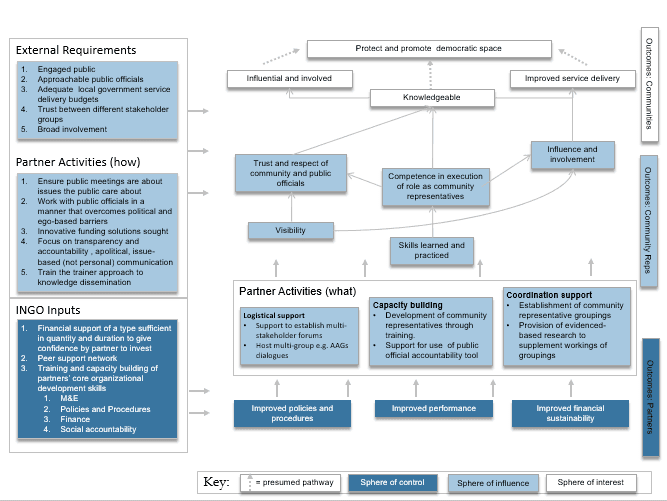
In Figure 1 the range of stakeholders potentially impacted by the project are represented in the Theory of Change in terms of their distance from PACT. Key implementing partners are represented within PACT’s sphere of control. The community representatives, who are supported by the Partners, feature within PACT’s sphere of influence. Finally, the wider communities that are served by the community representatives are considered to be within PACT’s sphere of interest. The use of spheres is a helpful way to consider the ability of PACT to impact different stakeholder groups.
